Hello, and welcome to CELITA CLINIC in Busan Seomyeon.
Among the questions we hear most often in our consultation room, one stands out: Ultherapy.
Many patients walk in curious but a little hesitant. So today, for those of you who have paused at the question "Will Ultherapy actually work for me?" — let's walk through the answer together.
In the consultation room, the questions patients bring tend to split into two. "Is this treatment right for me?" and "Will this clinic deliver exactly what they promise?" For those traveling to Busan from Japan, Taiwan, or English-speaking countries, the second question carries more weight. That's a completely reasonable concern.
In this guide, we cover who Ultherapy isn't recommended for, how to get the most out of it, and four things you can verify yourself before the procedure. Individual results may vary, but informed decisions are something everyone deserves.
How Does Ultherapy Work?
Think of a magnifying glass focusing sunlight to a single point. Ultherapy uses high-intensity focused ultrasound (HIFU) to skip the skin's surface and deliver heat energy precisely to the deep SMAS layer (approximately 4.5mm below the skin). Small thermal coagulation points form at that depth, and your skin receives a signal to begin producing new collagen. Visible changes typically appear gradually over about 2 to 3 months.
Cases Where Ultherapy May Not Be the Right Fit
Ultherapy is an excellent treatment, but it isn't the right answer for everyone.
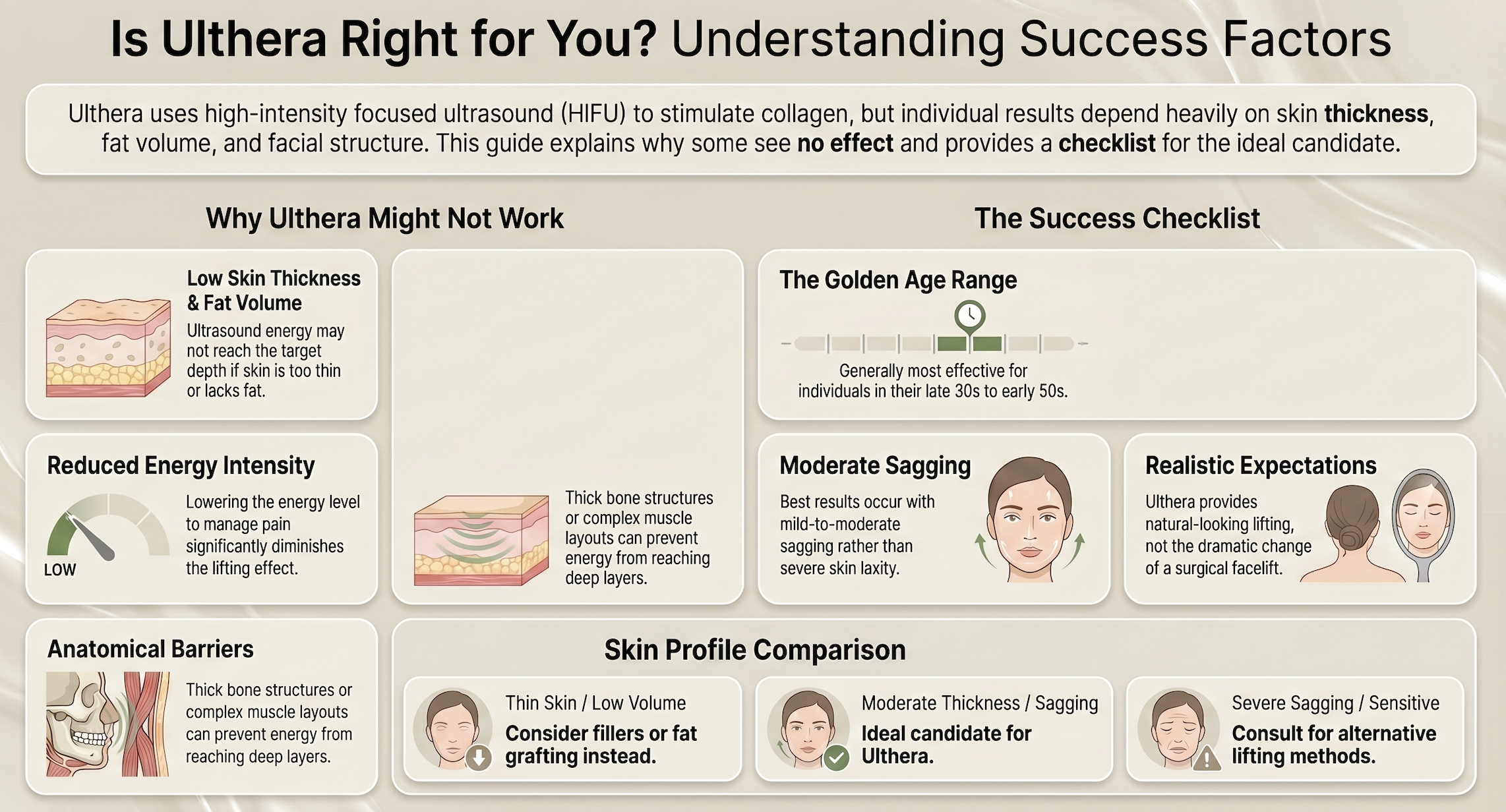
Thin skin with minimal facial fat As heat works through the tissue, the cheeks may appear more hollow than before. In these cases, it's more appropriate to design the treatment conservatively or to consider other procedures that target the dermal layer first.
Fine lines and skin texture are the main concern, not sagging Ultherapy is a structural lifting treatment that addresses the deep foundation of the face. Surface fine lines, pores, and skin texture aren't its primary target. Skin boosters or treatments focused on the superficial dermis may be a better match.
Pregnancy or breastfeeding Safety data for Ultherapy during pregnancy and breastfeeding has not been sufficiently established. At CELITA CLINIC, we discuss timing again once breastfeeding has ended.
Keloid tendency, autoimmune conditions, or metal implants in the treatment area Treatment may be limited for patients with a keloid tendency, active autoimmune disease, metal implants in the treatment area, or active infection or wounds at the site.
Expecting immediate results from a single session Collagen regeneration takes time. If you have a major event in the next one to two weeks, we'd recommend discussing additional options together.
What People Who Respond Well to Ultherapy Have in Common
In our consultation room, patients who notice meaningful change tend to share a few traits. They are typically between their mid-30s and early 50s, with skin laxity that has just begun or is in progress. They consistently apply sunscreen and maintain a steady moisturizing routine after the procedure. The treatment itself matters, but daily habits afterward shape the result just as much.
Treatment Time and Downtime
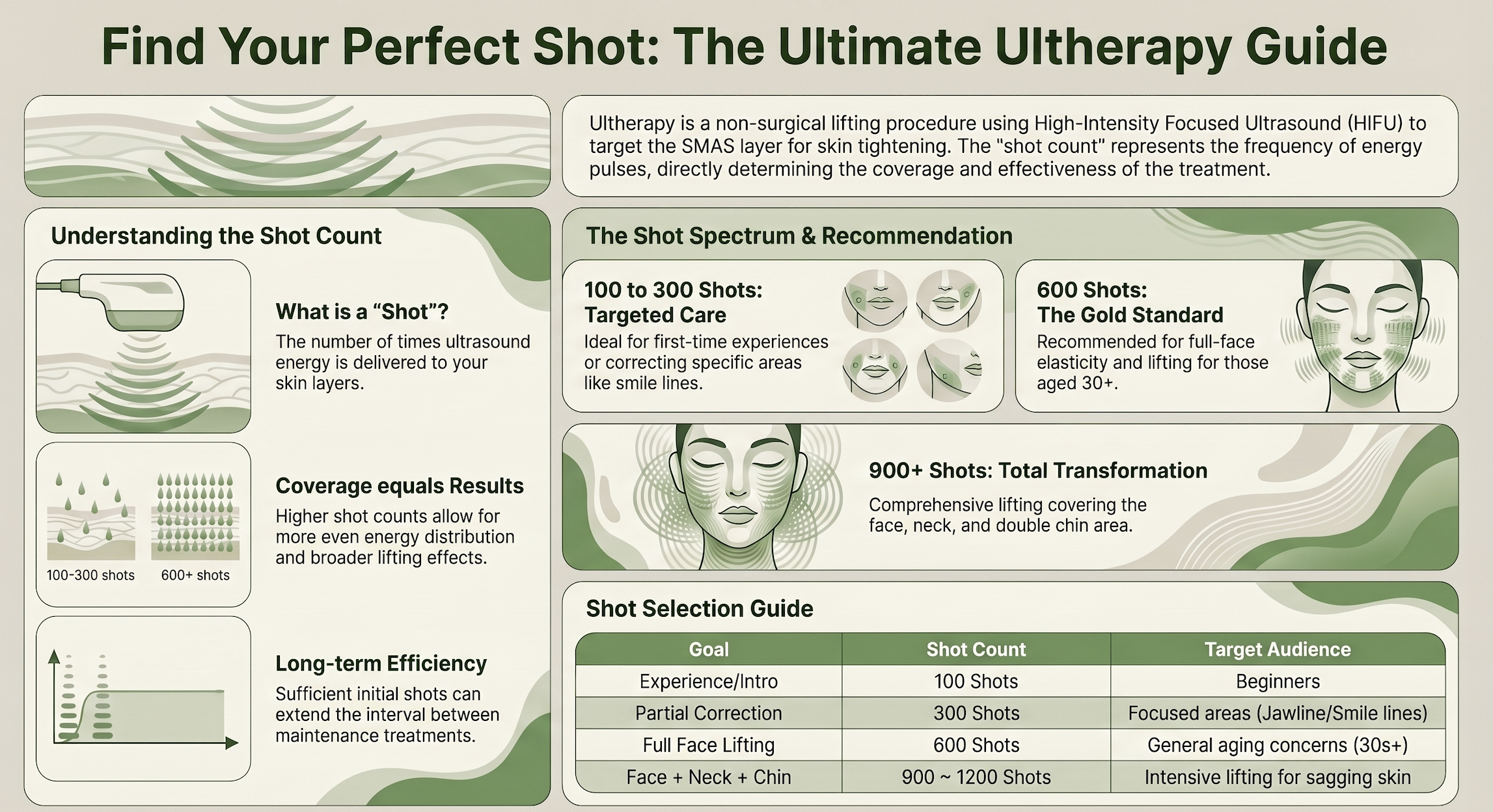
For a typical 300-shot treatment, the procedure takes approximately 20 to 30 minutes. Downtime is minimal in most cases.
Some patients experience mild redness for about 1 to 2 hours immediately after the procedure. Mild swelling or a slight tender, achy feeling when touched may continue for 3 to 5 days for some. These reactions don't interfere with daily activities or makeup, so you can continue with your schedule on the same day as the treatment.
If you're considering Ultherapy during a trip to Busan or a business visit, you can plan for normal activities both on the day of treatment and the following day.
Getting the Most Out of Ultherapy
About 2 weeks before treatment Avoid strong exfoliation, high-dose retinol, and heavy tanning. Recovery is smoother when your skin starts in a stable condition.
The first week after treatment Avoid saunas, jjimjilbangs (Korean spas), intense exercise, and alcohol, and be diligent with sunscreen. Gentle, low-irritation moisturizers are best during this period.
1 to 3 months after treatment This is the core window for collagen remodeling. Steady hydration, sleep, and sun protection help the changes settle in more clearly.
Four Things You Can Verify Yourself Before Treatment
The same machine name can produce different results depending on how a clinic operates. The following four items are things you, as a patient, can confirm directly before your procedure.
Ultrasound-guided treatment Ultherapy is performed with real-time ultrasound imaging that allows the practitioner to see the depth and structure of the tissue being treated. Whether ultrasound is actually used during the procedure to confirm the treatment area, depth, and energy setting directly affects both the precision and safety of the result. At CELITA CLINIC, ultrasound imaging guides every Ultherapy treatment plan.
Shot count display The Ulthera device displays the number of shots used in real time. You can check, for yourself, whether the shot count quoted matches the shot count actually used.
VAT-inclusive pricing disclosed in advance A pre-treatment quote should list the procedure name, target area, shot count, and the VAT-inclusive total. If additional treatment becomes necessary, separate consent must be confirmed before any additional procedure begins. No cost should appear after the fact that wasn't agreed upon beforehand.
Objective measurement before treatment With objective measurement tools like Eve V MUSE AI skin analysis, CELITA CLINIC checks your skin condition with data-supported precision before the procedure begins.
What This Means for Choosing a Clinic
These four points naturally become criteria you can use when choosing a clinic. Is the procedure guided by real-time ultrasound? Is shot count visible and verifiable? Is pricing fully disclosed before treatment? Is your skin condition measured objectively before the procedure? Information on possible side effects appears in the FAQ section below.
How CELITA CLINIC Operates Ultherapy Treatment
Eve V MUSE AI skin analysis-based treatment design Before treatment, your skin is measured using Eve V MUSE AI skin analysis, and the treatment is designed based on those results.
VAT-inclusive pricing disclosed in advance The pre-treatment quote lists the VAT-inclusive total. No costs appear later that weren't agreed upon beforehand.
Busan Seomyeon accessibility CELITA CLINIC is located on the 4th floor of Bujeon Medical Plaza, 751 Jungang-daero, Busanjin-gu, Busan — a one-minute walk from Seomyeon Station. Dedicated coordinators for Korean, English, Japanese, Chinese, and Spanish are on standby during consultation hours, so you can communicate in your own language before and after the procedure.
Quick Summary
Ultherapy focuses ultrasound energy on the SMAS layer (approximately 4.5mm deep) to re-awaken collagen — much like a magnifying glass concentrating sunlight. Visible change typically appears gradually over 2 to 3 months.
A typical 300-shot treatment takes about 20 to 30 minutes, with minimal downtime — most patients can continue with their schedule the same day.
Ultherapy isn't right for everyone. Patients with very thin skin, those whose primary concern is fine lines, those who are pregnant or breastfeeding, those with keloid tendency, autoimmune conditions, or metal implants in the treatment area, and those expecting immediate results may want to reconsider.
Four things you can verify before treatment: ultrasound used during the procedure, shot count display, VAT-inclusive pricing in advance, and Eve V MUSE AI measurement before treatment. CELITA CLINIC follows these as operating principles.
Frequently Asked Questions
Q. Will I see results right after one Ultherapy session?
A. Changes typically appear gradually over about 2 to 3 months. Collagen needs time to respond. If you have an event in the next one to two weeks, we'd suggest discussing additional options together.
Q. Is the treatment painful?
A. At CELITA CLINIC, we manage discomfort with topical anesthetic before the procedure and by adjusting energy settings during it.
Q. How long do swelling and bruising last?
A. Most reactions settle within a few days. Mild swelling, tenderness, or light bruising can be part of normal recovery. Less commonly, temporary asymmetry or short-term changes in sensation may occur. If anything concerns you, contact us during consultation hours and we'll check it for you immediately.
Q. Can Ultherapy be combined with other treatments?
A. Ultherapy works at the deep SMAS layer, while skin boosters work at the dermal layer. Whether and in what order to combine treatments is decided during your in-clinic consultation.
Booking and Inquiries
For Ultherapy consultations and bookings, please reach us through the CELITA CLINIC website. Before treatment, a consultation and Eve V MUSE AI skin analysis are conducted to design a treatment plan suited to your skin and to share a VAT-inclusive quote.
This content is for informational purposes only and is not a substitute for medical advice. Individual results may vary depending on skin condition. Please consult with qualified medical professionals before any procedure. This content was prepared in accordance with applicable medical advertising standards.